



In a hurry? Read this summary:
- XIRR (extended internal rate of return) shows the real return by timing every cash inflow and outflow, not just average growth.
- For uneven SIPs, XIRR reveals the true outcome.
- Favoured for accuracy and consistency, XIRR handles withdrawals, dividends and partial redemptions.
XIRR in mutual fund
When you invest a fixed amount paid at regular intervals over the course of the year, you can easily calculate the compound annual growth rate (CAGR) on your investment. However, when an investment involves varying cash inflows (such as SIP or cash outflows such SWP, dividends or any partial redemptions) it’s a lot harder to get true annual returns.
This is where XIRR (extended internal rate of return) can be a helpful tool for investors.
What is XIRR in mutual funds?
XIRR, or Extended Internal Rate of Return, is a financial metric that helps investors understand the annualized rate of return for a series of cash flows that occur at irregular intervals. The way investments are structured in a SIP makes it difficult to clearly understand the rate of return, however XIRR simplifies the process. It takes into account the dates of investment and withdrawal, the timing of the cash flow, and any fees and charges associated with he investment. These factors give investors a better picture of how their investment has performed.
XIRR is a useful metric for investors who favour mutual funds/SIPs, but it may also make sense for private equity and venture capital investments where cashflow may vary.
How to find XIRR for mutual funds?
The mathematical formula for calculating XIRR in mutual funds is expressed as:

This formula is complex and may not be practical for layman investors looking to evaluate their portfolio. Fortunately, you can use spreadsheets like Microsoft Excel to easily find XIRR for your SIPs.
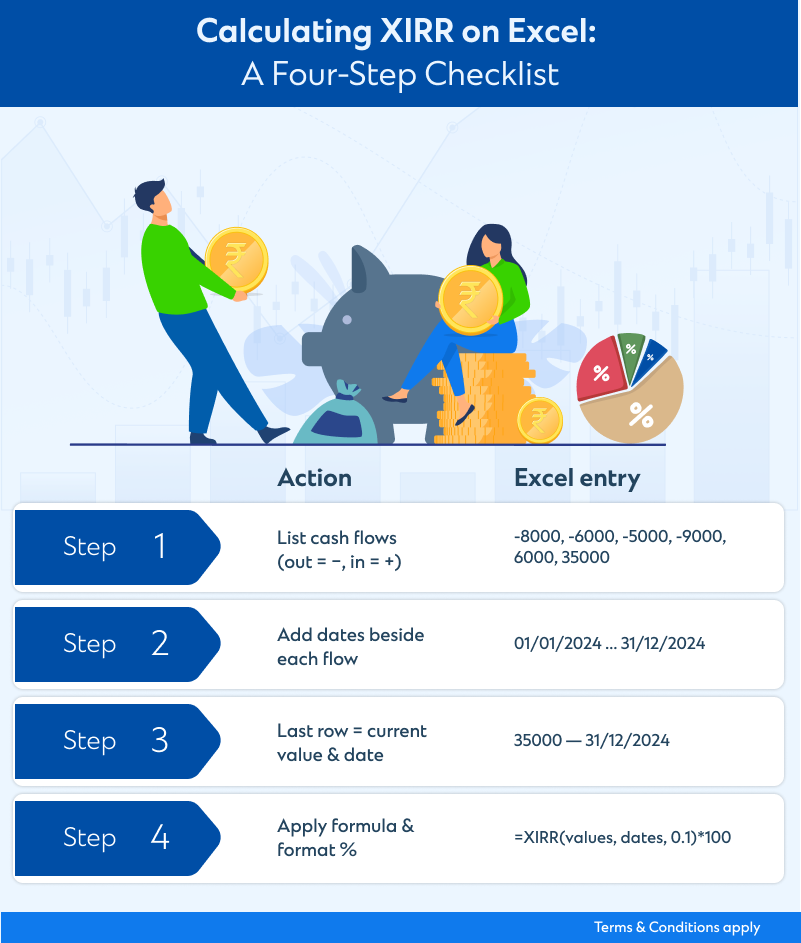
Find XIRR using excel
The following are the steps to calculate XIRR in excel
Step 2: Enter the respective dates in another column
Step 3: In the last row, enter the current value of the holding and the current date
Step 4: Use the XIRR formula in Excel: =XIRR(values, date, guess).
Here, values contain the range of transactions, and dates contain the range of dates on which these transactions happened. The guess is optional, and Excel picks the default 0.1 value for it if nothing is entered.
XIRR in Excel: 4 quick steps

Example of XIRR in excel
Let’s say you have made the following SIP at the given dates.
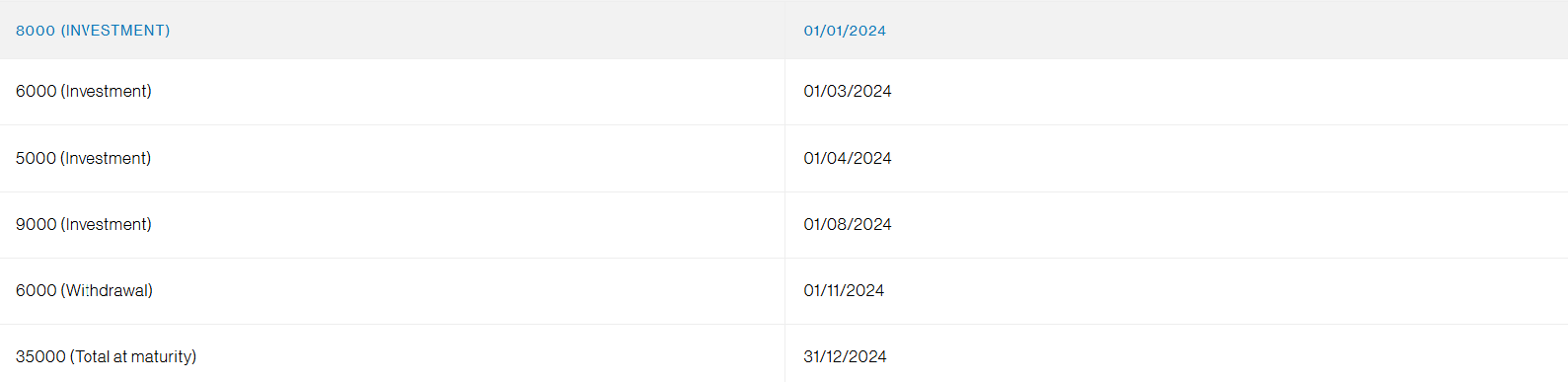
In excel, do the following:
In column B2, add -8000 (negative because it’s a cash outflow)
In column B3, add -6000
In column B4, add -5000
In column B5, add -9000
In column B6, add 6000
In column B6, add 35000
Do a similar exercise for dates and add them in column A for the respective transactions, as shown below in the image.
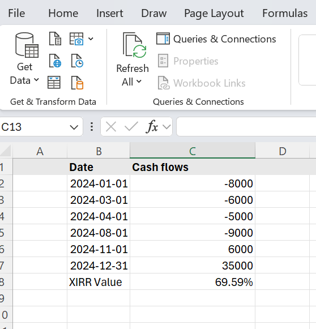
Now use the XIRR formula.” =XIRR(B2:B7, A2:A7,0.1) ” and hit enter to get the XIRR. To get the XIRR in percentage, format the cell to a percentage data type.
The XIRR is 69.59%.
Benefits of using XIRR in mutual funds
Using XIRR comes with its share of benefits.
- Accuracy: XIRR provides a great deal of accuracy for all the cash flows, factoring in their exact timings.
- Steadiness: It always provides a consistent return measurement, even when cash flows are irregular, unlike CAGR, which may mislead with wrong returns for irregular cash flows.
- Adaptability: It provides versatility in calculating returns with any investment type, irrespective of the cash flows’ irregularities, making it a reliable tool to evaluate investment performance.
- Clarity: XIRR provides transparent return evaluations by counting on actual cash flows.
How does XIRR compare to similar metrics?
XIRR is not the only metric investors may use to evaluate returns, but it’s usually the one that offers the most accurate results. Learn how XIRR compared to other options like IRR, CAGR, etc.
- Annualized Return (CAGR): CAGR (Compound Annual Growth Rate) shows the annual growth rate of an investment over a given term. The limitation of this metric is that it assumes the investment compounds and there are no additional withdrawals or contributions. It’s suitable for lump sum investments but not SIPs.
- Internal Rate of Return (IRR): IRR is the discount rate that makes the net present value (NPV) of all cash flows equal to zero. IRR can be used in projects where cash flows happen at fixed intervals, but if intervals vary, IRR becomes inaccurate. IRR can be used for SIPs, but XIRR provides a more precise result.
- NPV (Net Present Value): NPV tells you the current value of all future cash flows, discounted at a chosen rate (often a required rate of return). NPV can help you determine how much your investment is worth, but it does not give you an annualized rate. Additionally, you must know or assume a discount rate.
Ultimately, if your investment involves irregular deposits or withdrawals, XIRR is the gold standard. It reflects your true, annualized return, accounting for both timing and size of every cash flow and offers the most complete picture for investors.
To learn more, connect with our relationship managers or visit SC Invest and start building your mutual fund portfolio.



Standard Chartered Bank, India (‘Bank’) is an AMFI-registered distributor of mutual funds and referrer of other third-party investment products and does not provide any investment advisory services as defined under the SEBI (Investment Advisers) Regulations, 2013. Mutual fund investments are subject to market risks, please read scheme related documents carefully before investing. Past performance is not indicative of future returns. Apart from the RM-assisted journey, SC Invest is an EXECUTION-ONLY platform. The Bank does not provide any investment advice or investment recommendations in respect of any transaction effected through the SC Invest platform.
The contents on this webpage are for general information only and does not constitute an offer recommendation or solicitation of an offer to enter into a transaction or adopt any hedging, trading or investment strategy, nor does it constitute any prediction of likely future movements in rates or prices or any representation that any such future movements will not exceed those shown in any illustration. You are fully responsible for your investment decision, including whether the product or service described here is suitable for you. Standard Chartered Bank will not accept any responsibility or liability of any kind, with respect to the accuracy or completeness of the information in this webpage. The contents herein are for general evaluation only and has not been prepared to be suitable for any particular person or class of persons. Standard Chartered Bank makes no representation or warranty of any kind, express, implied or statutory regarding the contents on this webpage or any information contained or referred to herein. This webpage is distributed on the express understanding that, whilst the information in it is believed to be reliable, it has not been independently verified by us.
This communication has been prepared on the basis of publicly available information, internally developed data and other sources believed to be reliable. Standard Chartered Bank India (“SCB/ Bank”) does not warrant its completeness and accuracy. This information is not intended as an offer or solicitation for the purchase or sale of any financial instrument / units of Mutual Fund. Recipients of this information should rely on their own investigations and take their own professional advice. Neither SCB/Bank nor any of its employees shall be liable for any direct, indirect, special, incidental, consequential, punitive or exemplary damages, including lost profits arising in any way from the information contained in this material. SCB Bank and its affiliates, officers, directors, key managerial persons and employees, including persons involved in the preparation or issuance of this material may, from time to time, have investments / positions in Mutual Funds / schemes referred in the document.
Standard Chartered Bank (“SCB/ Bank”) is a AMFI-registered Mutual Fund Distributor & a Corporate Agent for Insurance products.