



Types of mutual funds based on assets
In a hurry? Read this summary:
- Mutual funds pool investors’ capital into a diversified portfolio of assets such as equities, debt instruments such as government and corporate bonds, as well as other assets such as real estate, gold, and more. They help balance growth with risk mitigation.
- They can be classified based on multiple categories, such as those based on their underlying assets, their structure, as well as goal-specific and specialised funds.
- Understanding each of these categories is essential for selecting the funds best suited to an investor’s financial goals, risk appetite, and investment horizon.
The key to building a resilient portfolio that weathers market cycles and creates lasting wealth lies in diversification. In India, Mutual Funds have long been a preferred means to this end. That said, different mutual funds cater to varying investor priorities — from long-term capital growth to high liquidity levels, and exposure across asset classes, market capitalisations, and/or sectors. Understanding the nuances of each of these types can help one choose the right type, aligned with their financial goals, risk profiles, liquidity preferences, as well as investment horizons.
A primer on mutual funds
Mutual funds pool their money into a diversified mix of assets that include equities, bonds, commodities, currencies, and more, across sectors, market capitalisations and/or geographies. The purpose behind this is to offset concentrated risks and balance capital appreciation with a stable income.
One can choose to invest in mutual funds both via systematic investment plans (SIPs) as well as a lumpsum payment.
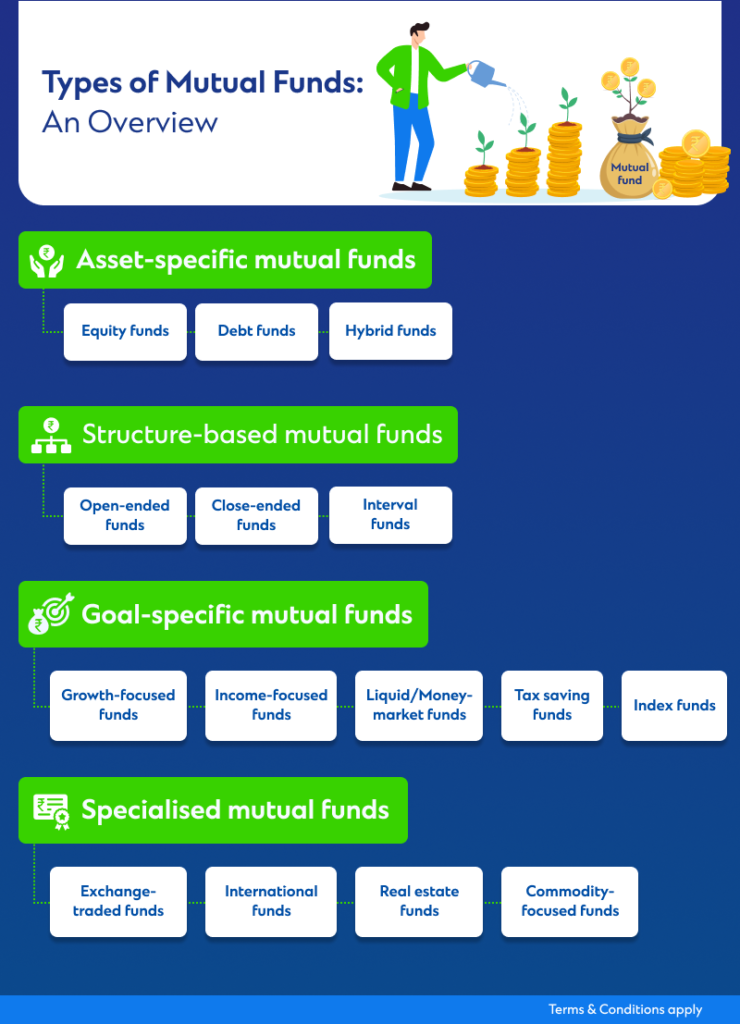
While this is broadly how mutual funds work, each category and type is structured differently. Here is what you need to know about each of them.
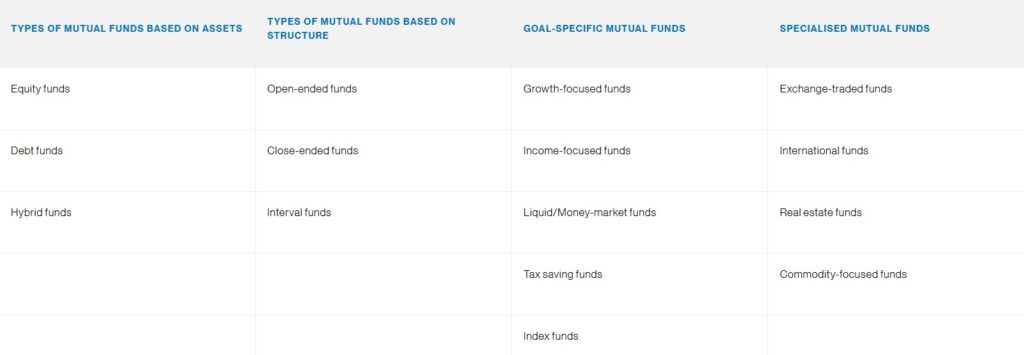
Types of mutual funds based on assets
Mutual funds are most commonly classified based on the asset classes they invest in, wherein each type helps fulfil a distinct set of financial objectives and suits specific risk profiles.
Equity funds
Equity funds invest a minimum of 65% of their assets in equities or equity-linked instruments. Geared towards capital appreciation, equity funds can potentially generate inflation-beating returns over time. Since their performance is market-linked, however, they are exposed to higher volatility levels as well. Risk-averse investors may prefer to limit their exposure to these funds.invest a minimum of 65% of their assets in equities or equity-linked instruments. Geared towards capital appreciation, equity funds can potentially generate inflation-beating returns over time. Since their performance is market-linked, however, they are exposed to higher volatility levels as well. Risk-averse investors may prefer to limit their exposure to these funds.
Debt funds
Debt mutual funds invest anywhere between 65% to 80% of their assets in instruments such as government and corporate bonds, certificates of deposit, and commercial papers. Their objective is capital preservation and the provision of a stable income. Interest payments on these funds are the primary source of returns on investments. Considering their relatively lower correlation with capital markets, debt funds are an attractive investment avenue for risk-averse investors.
Hybrid funds
Hybrid funds invest their capital in a mix of equity and debt instruments. This helps balance capital appreciation with a predictable income and helps mitigate portfolio volatility as well. This sub-category of funds is further divided into conservative, balanced, and aggressive hybrid funds depending upon percentage of assets they invest in equities and debt instruments, respectively.into conservative, balanced, and aggressive hybrid funds depending upon percentage of assets they invest in equities and debt instruments, respectively.
Types of mutual funds based on structure
This categorisation of mutual funds is defined by when investors can enter or exit a fund. Based on whether one can do so anytime, within a fixed period, or at intervals, they are classified into the following:
Open-ended funds
Open-ended funds are open for investments and redemptions at any time and are the most common form of mutual funds in India. They usually do not have any maximum limit on assets under management (or AUM) either. Their NAV (net asset value) is calculated daily, based on the value of their underlying securities.
Close-ended funds
Closed-ended mutual fund schemes generally have specific lock-in periods. One can invest in them only during the new fund offer (NFO) period and can redeem units only after the lock-in period or the tenure of the scheme expires. Some closed-ended funds, however, may transition to open-ended ones once this lock-in period is over. Alternatively, asset management companies (AMCs) may also transfer the proceeds from these funds to other open-ended funds.
Interval funds
These funds allow one to buy or sell units in them only during pre-specified periods, declared by the fund house. Investments and liquidation in them are otherwise restricted. These funds are closer in their workings to closed-ended funds. However, they offer a middle ground which still offers increased flexibility compared to the latter.
Goal-specific mutual funds
Depending on investor priorities, mutual funds can also be categorised as follows:
Growth-focused funds
These funds are geared towards capital appreciation for fulfilling long-term financial goals such as building a retirement corpus or funding one’s children’s education.
Income-focused funds
These funds focus on capital preservation and generating a stable, predictable income stream by investing in debt securities. These funds are a great way to fulfil short and medium-term goals such as building an emergency fund, taking a vacation abroad or buying a car.
Liquid/Money-market funds
These mutual funds typically invest in debt instruments with very short maturity timelines, and units can be redeemed at any time. Their primary objective is to provide investors with quick liquidity to tackle unforeseen contingencies such as accidents or illnesses, home or vehicle repairs, and so on.
Tax saving funds
These are designed to introduce tax efficiency to investor portfolios, allowing for up to ₹1,50,000 in tax deductions per annum. They are referred to as Equity-Linked Savings Scheme (ELSS) mutual funds and invest a minimum of 80% of their capital in equities or equity-linked instruments. Bear in mind that they have a lock-in period of three years, however.
Specialised mutual funds
Specialised mutual funds are designed for exposure to specific geographies, asset classes, or investment themes. A few examples of these mutual funds are:
Index funds
These mutual funds aim to track and replicate the performance of specific market indices such as the Nifty 50 or Sensex. Index funds are passively managed and invest in the constituents of their underlying indices in the same proportion. They are best suited to investors with a low to moderate risk profile.
Exchange-traded funds
Exchange-traded funds(ETFs) combine the diversification offered by mutual funds with the liquidity of stocks. These mutual funds can be traded on stock exchanges throughout the trading day. Similar to other specialised mutual funds, they track specific indices, sectors, or commodities, offering investors diversified market exposure to mitigate concentrated risks.
International funds
International funds invest in stocks of foreign companies and other debt securities outside of an investor’s home country. They allow one to gain exposure to markets globally, even though they have higher levels of risk associated with them, such as those stemming from exchange rate.
Real estate funds
These invest in stocks of listed real estate development companies, or real estate investment trusts (REITs). REITs own, operate and/or finance income-producing real estate. They enable one to invest in large-scale real estate development projects without having to actually purchase them. These can include office buildings, apartments, or even shopping malls. Investors receive regular income through rent as well as dividends, and may also potentially see their capital appreciate, too.
Commodity-focused funds
Commodity funds invest in companies involved in the production or trade of commodities such as oil, precious metals, agricultural products, and more. Some funds even hold some of these commodities directly, such as gold or silver.
Each of the broader categories of mutual funds caters to specific financial goals, risk profiles, and investment horizons. Bear in mind, however, that within these also lie several sub-types such as large, mid, and small-cap funds, flexi-cap and multi-cap funds, dynamic bond funds, gilt funds, and more. Each of these sub-types is designed to further streamline and bolster one’s portfolio to meet specific financial objectives.
Understanding the various kinds of mutual funds can help one construct well-rounded and resilient portfolios that can consistently deliver returns across market cycles. To get started on your mutual fund investment journey, visit SC Invest on the SC Mobile app or contact your relationship manager at Standard Chartered Bank today.



Standard Chartered Bank, India (‘Bank’) is an AMFI-registered distributor of mutual funds and referrer of other third-party investment products and does not provide any investment advisory services as defined under the SEBI (Investment Advisers) Regulations, 2013. Mutual fund investments are subject to market risks, please read scheme related documents carefully before investing. Past performance is not indicative of future returns. Apart from the RM-assisted journey, SC Invest is an EXECUTION-ONLY platform. The Bank does not provide any investment advice or investment recommendations in respect of any transaction effected through the SC Invest platform.
The contents on this webpage are for general information only and does not constitute an offer recommendation or solicitation of an offer to enter into a transaction or adopt any hedging, trading or investment strategy, nor does it constitute any prediction of likely future movements in rates or prices or any representation that any such future movements will not exceed those shown in any illustration. You are fully responsible for your investment decision, including whether the product or service described here is suitable for you. Standard Chartered Bank will not accept any responsibility or liability of any kind, with respect to the accuracy or completeness of the information in this webpage. The contents herein are for general evaluation only and has not been prepared to be suitable for any particular person or class of persons. Standard Chartered Bank makes no representation or warranty of any kind, express, implied or statutory regarding the contents on this webpage or any information contained or referred to herein. This webpage is distributed on the express understanding that, whilst the information in it is believed to be reliable, it has not been independently verified by us.
This communication has been prepared on the basis of publicly available information, internally developed data and other sources believed to be reliable. Standard Chartered Bank India (“SCB/ Bank”) does not warrant its completeness and accuracy. This information is not intended as an offer or solicitation for the purchase or sale of any financial instrument / units of Mutual Fund. Recipients of this information should rely on their own investigations and take their own professional advice. Neither SCB/Bank nor any of its employees shall be liable for any direct, indirect, special, incidental, consequential, punitive or exemplary damages, including lost profits arising in any way from the information contained in this material. SCB Bank and its affiliates, officers, directors, key managerial persons and employees, including persons involved in the preparation or issuance of this material may, from time to time, have investments / positions in Mutual Funds / schemes referred in the document.
Standard Chartered Bank (“SCB/ Bank”) is a AMFI-registered Mutual Fund Distributor & a Corporate Agent for Insurance products.